


The US 380 Corridor Is Growing—Here’s What It Means at Home
See how growth along the US 380 corridor is reshaping Little Elm, Frisco, Prosper, Celina, McKinney and Princeton—and what readers can follow next.
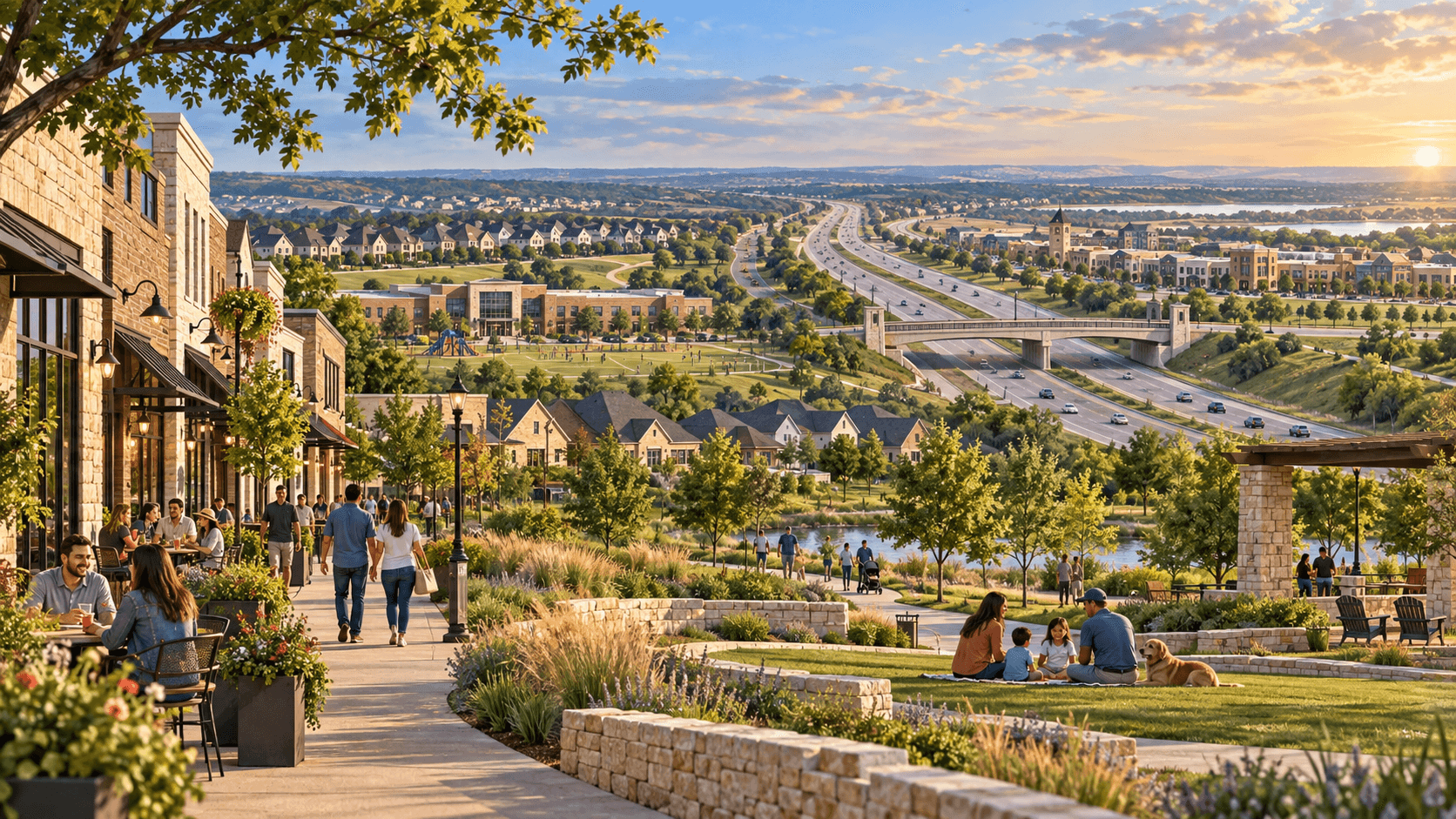
On US 380, the morning commute is rarely only a commute.
It can also be the school drop-off, the medical appointment, an errand on the way home and the route to a local business.
Across Little Elm, Frisco, Prosper, Celina, McKinney and Princeton, growth is changing the daily map: where households look for housing, what businesses can reach customers and which roads carry more trips.
IMS Relocation’s original overview asked why the corridor was growing.
One corridor, several growth stories
In estimates released May 28, 2026, the North Central Texas Council of Governments counted 203,786 residents added across its 16-county region during 2025, bringing the population to 8,952,590.
That is a regional total, not a head count for the US 380 corridor alone.
NCTCOG’s 2025 city estimates show Celina adding 16,813 residents, McKinney 6,110, Frisco 5,923, Princeton 4,404, Prosper 3,268 and Little Elm 1,341.
Those are changes in each city’s full population, and the communities are growing at different rates.
NCTCOG also reports the region’s population center continuing to shift north and slightly east, part of the wider context for the corridor.
Housing is the start of the story
Where people live shapes their week.
School runs, grocery trips, healthcare, work, parks and time with family all depend on how housing connects to everyday services.
In 2025, NCTCOG counted 42,445 new single-family units and 42,582 new multifamily units across the region, not just along US 380.
That near-even split is a reminder that growth can mean a new subdivision in one place and apartments closer to shops or services in another.
Planning for growth therefore reaches beyond approving homes to water, roads, schools, parks and the services that help a neighborhood feel complete.
What makes a community feel like home
More households can mean more potential customers for restaurants, childcare, health providers, repair shops and other local businesses.
It can also bring more service traffic and harder access while roads or utilities are under construction.
Growth can help a business district thrive, but the result depends on access, planning and whether new investment connects to the existing community.
Community amenities are part of that connection.
Frisco opened its 122-acre Northwest Community Park on September 19, 2026, with more than 10 miles of trails, playgrounds, a splash pad, a dog park and outdoor learning space.
The city says the park also preserves Blackland Prairie habitat and serves residents with a range of ages and interests.
Celina is linking growth to downtown in a different way.
In July, the city and its Economic Development Corporation announced Trackside Junction, a planned $15 million public-private project with 15,000 square feet of new commercial space.
The plan includes retail, restaurants, offices, event space and residences, aiming to connect Celina’s historic square with its growing Entertainment District.
Trackside Junction is still a plan, but it signals an effort to pair new investment with places to meet, shop and spend time.
Prosper, McKinney, Princeton and Little Elm each have their own plans and priorities, so regional numbers are a beginning rather than a verdict on any one town.
Transportation changes the everyday equation
The shared challenge is often the road people use to reach everything else.
Community Impact’s April report, published April 22, described a Denton County US 380 improvement project near Prosper that added overpasses at five major intersections, improved medians and turn lanes, and added a lane in each direction.
The report also described construction effects on drivers and businesses, alongside local officials’ hope that the improvements would ease pressure on the road.
That is the trade-off residents recognize: a finished improvement may make a familiar trip easier, while construction can reroute customers and push traffic onto local streets.
TxDOT’s project overview separates the long-range corridor plan from what is funded and moving now.
In Collin County, US 380 is divided into five independent project segments that TxDOT says will advance on different schedules based on traffic needs and funding.
TxDOT reports environmental study, preliminary engineering and alignment selection completed in four segments; Princeton’s segment remains at a different planning stage.
So there is no single timeline meaning every mile will become a freeway at once.
For people who drive the route, the practical step is to follow the specific city and segment they use rather than rely on a broad headline or old estimate.
TxDOT’s searchable Project Tracker lets residents search by highway, county or project number, while city plans and meeting notices explain nearby changes to parks, utilities, schools and local roads.
Those details matter whether someone is weighing a move, navigating appointments or trying to support a local shop during construction.
Three quick answers for corridor readers
Q: What does the 203,786 figure measure?
A: It is NCTCOG’s estimate of population added across its 16-county North Central Texas region in 2025, not a count for the US 380 corridor alone.
Q: Does growth mean all six communities will change in the same way?
A: No, their population gains differ in size and pace, and each city makes its own choices about housing, businesses, amenities and services.
Q: Is the whole US 380 corridor on one freeway schedule?
A: No, TxDOT has divided Collin County work into separate segments that advance at different times based on funding and traffic needs. |
Never miss a story.
Get the best of The 380 Connector™ in your inbox — free, no spam.


0 Comments
Join the conversation
Be the first to comment
Share your thoughts above.